

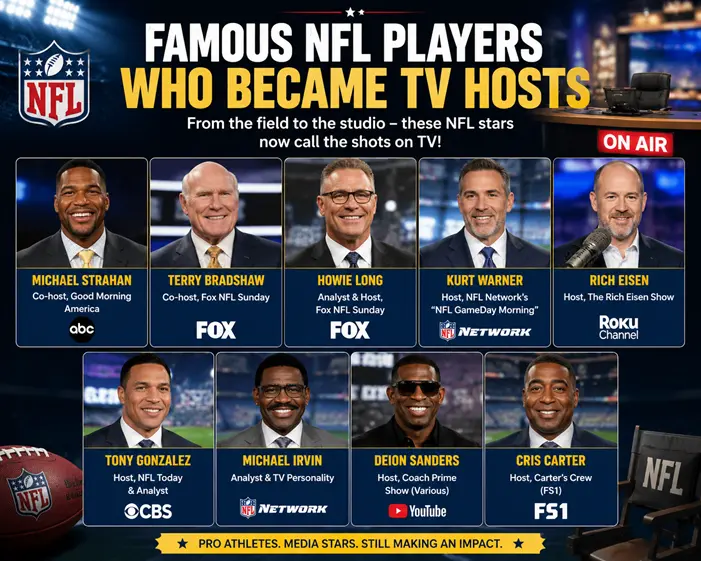
A great NFL career can end with retirement, but for some players, the microphone becomes the next playing field. Michael Strahan went from terrorizing quarterbacks to interviewing celebrities on Good Morning America. Terry Bradshaw turned his larger-than-life personality into decades of television success. Ahmad Rashad even became the face of one of basketball’s most influential TV shows. These famous NFL players who became TV hosts prove that athletic fame can be a starting point, not an ending.
Quick Summary: NFL Players Who Became TV Hosts
- Michael Strahan built one of the most successful post-NFL television careers.
- Terry Bradshaw became a defining personality on FOX NFL SUNDAY.
- Ahmad Rashad successfully crossed from NFL football into NBA television.
- Shannon Sharpe developed from NFL analyst into a major sports-talk personality.
- Howie Long and Tony Gonzalez became familiar faces on national sports television.
- The best former players succeed on TV because they combine football knowledge with personality, storytelling and interview skills.
Why Do Former NFL Players Make Good TV Hosts?
The transition from professional football to television can look easy from the outside. It isn’t.
An NFL player is trained to perform under pressure, communicate quickly and understand personalities inside a locker room. Those skills can transfer surprisingly well to television. A former player also brings something viewers cannot get from a traditional journalist: firsthand knowledge of what it feels like to prepare for an NFL game, handle criticism, deal with coaches and compete in front of millions of people.
But football knowledge alone does not make someone a successful host.
A good television personality has to listen, ask useful questions, react naturally and keep a segment moving. The most successful former players learned how to turn their athletic credibility into entertainment value.
That is why the careers of Strahan, Bradshaw and Rashad are particularly interesting. They didn’t simply appear on sports broadcasts after retirement. They developed personalities that worked beyond the football field.
1. Michael Strahan: From NFL Defensive End to Major TV Personality
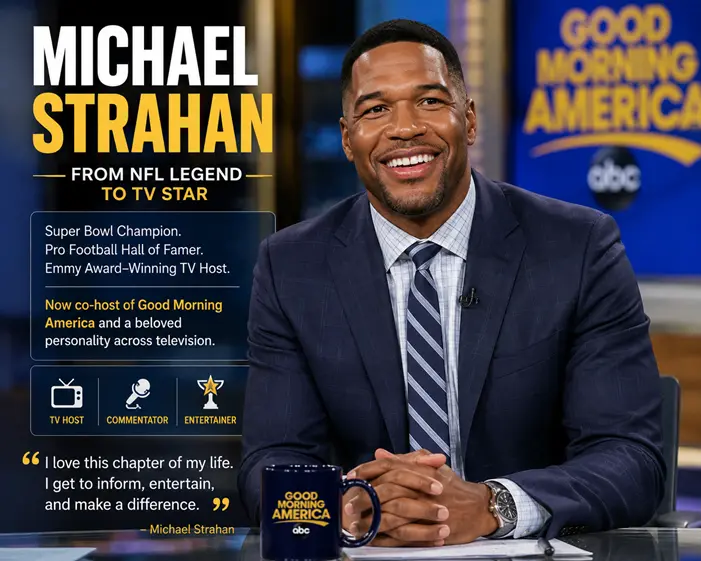
Michael Strahan may be the clearest modern example of an NFL player successfully becoming a mainstream television host.
Strahan spent his entire NFL career with the New York Giants and became one of the league’s most recognizable defensive players. He finished his career with 141.5 sacks and helped the Giants win Super Bowl XLII. After retirement, however, his professional identity changed dramatically.
He first became a prominent football television personality before moving into broader entertainment and morning television.
Today, ABC identifies Strahan as a co-anchor of Good Morning America and the host of The $100,000 Pyramid. His television career has included interviews with politicians, entertainers, athletes and other public figures.
What made Strahan’s transition different?
Personality.
Strahan’s television appeal isn’t based solely on his NFL résumé. He is comfortable joking with guests, asking personal questions and switching between serious interviews and entertainment segments.
His work on The $100,000 Pyramid is especially useful evidence of how far his career traveled. Hosting a game show requires a different rhythm from analyzing a football game. The host has to explain rules, interact with contestants, build suspense and maintain energy.
Strahan managed that transition without losing the credibility he earned in football.
His career demonstrates an important point: the best NFL-to-TV transitions don’t necessarily keep the athlete inside sports television.
2. Terry Bradshaw: The NFL Quarterback Who Became a Television Institution
Terry Bradshaw’s television career is almost as recognizable as his playing career.
Before becoming a broadcaster, Bradshaw was the quarterback of the Pittsburgh Steelers and won four Super Bowls. After retiring, he developed a reputation for being energetic, outspoken and funny on television.
FOX Sports lists Bradshaw as a co-host and analyst on FOX NFL SUNDAY, where he has been part of the program since its launch in 1994. The network says his work has earned him three Sports Emmy Awards in the Outstanding Sports Personality/Analyst category.
That longevity matters.
A former athlete can get television opportunities because of name recognition. Staying relevant for decades requires something else.
Bradshaw has that something.
He has never tried to sound like a traditional sports journalist. His appeal comes from being himself: emotional, humorous, unpredictable and willing to make strong observations. That personality helped turn FOX NFL SUNDAY into more than a standard pregame analysis program.
Bradshaw also demonstrates how a former player can become an entertainer without abandoning football expertise. He can break down a matchup one moment and become the comic personality of the segment the next.
For viewers who grew up watching NFL television in the 1990s and 2000s, Bradshaw became part of the Sunday football routine.
3. Ahmad Rashad: The NFL Star Who Became a Basketball TV Pioneer
Ahmad Rashad has one of the most unusual television journeys on this list.
Rashad was a four-time Pro Bowl wide receiver with the Minnesota Vikings, but his biggest television success came after football and, surprisingly, in basketball.
He became the host, executive producer and managing editor of NBA Inside Stuff, a show that gave viewers behind-the-scenes access to NBA players and their lives away from the court. NBA.com notes that Rashad hosted the program for 16 seasons and that the series later received the Naismith Basketball Hall of Fame’s Curt Gowdy Transformative Media Award.
That achievement is easy to underestimate.
NBA Inside Stuff wasn’t simply a highlights program. Rashad interviewed players, visited their homes, explored their hobbies and presented basketball stars as personalities rather than just athletes. The show’s format helped establish a style of sports storytelling that feels familiar today.
Rashad also worked across NBC and ABC sports programming, hosted Olympic coverage and appeared in various entertainment projects. The Charlotte Hornets’ official biography describes his extensive work as a host, executive producer, commentator and studio personality.
His story is particularly valuable because it shows that an NFL background can open doors outside the NFL itself.
In fact, Rashad’s television identity became so strongly associated with basketball that younger viewers may know him primarily as the face of Inside Stuff rather than as a former Vikings star.
4. Shannon Sharpe: From NFL Tight End to Sports-Talk Co-Host
Shannon Sharpe took a different route.
A three-time Super Bowl champion and Pro Football Hall of Fame tight end, Sharpe moved into broadcasting after retiring from the NFL. He began his television career with CBS Sports’ The NFL Today in 2004, appearing on pregame, halftime and postgame programming.
His personality eventually became as important as his football expertise.
Sharpe became widely known as the co-host of FS1’s Skip and Shannon: Undisputed, where he debated sports topics alongside Skip Bayless. FOX Sports described the program as a sports opinion and debate show, giving Sharpe a platform that demanded more than traditional game analysis.
This was a significant evolution.
Instead of simply explaining defensive schemes or discussing upcoming games, Sharpe had to develop arguments, challenge another host, tell stories and create television moments.
That is a completely different skill set.
Sharpe’s broadcasting career also illustrates how former NFL players can build a media identity around their voice. His willingness to express strong opinions became central to his television persona.
His later media work, including Club Shay Shay, further expanded that identity into long-form interviews and digital programming. FOX Sports reported the launch of the podcast in 2020, featuring conversations with prominent guests and former athletes.
5. Howie Long: The Defensive End Who Became a TV Mainstay
Howie Long’s transition from NFL defensive end to television personality has been remarkably durable.
Long played 13 seasons for the Raiders and established himself as one of the league’s premier defensive linemen. After retiring, he became a foundational member of FOX NFL SUNDAY.
FOX Sports says Long has served as an analyst on the program since its inception in 1994. He also received a Sports Emmy for Outstanding Studio Analyst and accumulated 10 consecutive nominations in the category from 1997 through 2006.
Long’s appeal is different from Bradshaw’s.
Where Bradshaw often leans into humor and spontaneity, Long brings a calmer presence and a detailed understanding of football. His ability to explain what players and coaches are thinking helps translate complicated football situations for viewers.
He also became a familiar face outside football broadcasting, appearing in movies and commercials and developing a recognizable entertainment persona.
That combination—football authority without being overly technical—helped Long remain relevant on television for decades.
6. Tony Gonzalez: An Elite Tight End Who Moved Into Sports Television
Tony Gonzalez is another strong example of an NFL star moving naturally into broadcasting.
Gonzalez spent 17 seasons in the NFL with the Kansas City Chiefs and Atlanta Falcons and became one of the greatest tight ends in league history. After retirement, he moved into television analysis.
CBS hired Gonzalez for The NFL Today in 2014, where he joined the network’s studio coverage.
He later became a fixture on FOX Sports programming. FOX currently lists Gonzalez as a studio analyst and notes his role on FOX NFL KICKOFF.
Gonzalez’s television style is built around credibility and explanation. A player who spent nearly two decades reading defensive coverages and competing against elite NFL defenses can provide context that viewers simply cannot get from statistics alone.
His transition also highlights the difference between a TV host and a TV personality.
Not every former NFL player stands alone as the primary host of a show. Some become analysts, co-hosts or recurring studio personalities. Yet their presence can be central to the program’s identity.
What Separates Successful NFL Broadcasters From Everyone Else?
Thousands of former professional athletes have appeared on television. Only a small number become recognizable TV personalities.
So what makes the difference?
1. Personality matters as much as expertise
Viewers don’t tune in simply because someone played football. They return because they enjoy listening to that person.
Bradshaw’s humor, Strahan’s warmth, Sharpe’s confidence and Long’s measured analysis demonstrate different ways personality can work.
2. Storytelling creates connection
Former players have access to stories that ordinary commentators don’t.
They know what happens inside locker rooms. They understand the pressure of playing in a Super Bowl. They have experienced coaching changes, injuries, trades and media scrutiny.
The challenge is turning those experiences into stories viewers can understand.
3. Television requires flexibility
A football player might spend three hours preparing for one game. A television personality may have to discuss football, entertainment, current events and personal stories within the same hour.
Strahan’s career demonstrates this flexibility particularly well. His roles have moved far beyond football, from Good Morning America to The $100,000 Pyramid.
4. Chemistry matters
Sports television is rarely a one-person operation.
Bradshaw’s long-running relationship with the FOX NFL SUNDAY cast is a good example. FOX’s studio format has paired former players with a traditional host, creating a mixture of football expertise and entertainment.
Sharpe’s debate format with Skip Bayless worked for a similar reason: disagreement itself became part of the entertainment.
Are NFL Players Better TV Hosts Than Traditional Broadcasters?
Not necessarily.
A former NFL player has built-in credibility, but credibility doesn’t automatically create good television. Some athletes are excellent analysts but uncomfortable hosts. Others are natural entertainers but struggle to explain complex sports topics.
The most successful personalities combine both.
That is why the examples above are useful. Strahan demonstrated mainstream hosting ability. Bradshaw developed decades of studio chemistry. Rashad became a pioneering personality in another professional sport. Sharpe built a recognizable debate persona. Long established himself as a trusted studio analyst, while Gonzalez developed into a polished football television personality.
The common thread isn’t simply NFL fame.
It is communication.
Why Former NFL Players Continue Moving Into Television
The relationship between professional sports and television has changed dramatically.
Networks increasingly want recognizable personalities who can generate conversation before, during and after games. Former players bring instant name recognition and firsthand experience. Streaming platforms, podcasts and social media have also expanded the number of places where athletes can build audiences.
That creates more opportunities for former NFL players to become interviewers, analysts, commentators, hosts and digital creators.
Ahmad Rashad’s career is an early example of this evolution. His NBA Inside Stuff work showed that an athlete could become a bridge between sports and entertainment rather than simply another former player behind a studio desk. NBA.com has continued to feature Rashad in interview projects decades after the original show’s run, demonstrating the durability of his television identity.
The modern media environment simply gives former athletes more ways to extend that career.
Frequently Asked Questions
Which NFL player became the most famous TV host?
Michael Strahan is one of the strongest examples. After his NFL career with the New York Giants, he became a major television personality, serving as a Good Morning America co-anchor and host of The $100,000 Pyramid.
Did Terry Bradshaw become a TV host after playing in the NFL?
Yes. Bradshaw became a longtime television personality after his Steelers career and has been part of FOX NFL SUNDAY since its launch in 1994. He combines football analysis with humor and entertainment.
Which former NFL player hosted NBA Inside Stuff?
Ahmad Rashad hosted NBA Inside Stuff for 16 seasons. The former Minnesota Vikings Pro Bowl receiver became one of the most recognizable hosts in basketball television history.
Why do former NFL players move into television?
Television gives former players a way to use their football knowledge, public profile and communication skills after retirement. The strongest personalities can move beyond analysis into hosting, interviewing, entertainment and sports debate.
Conclusion
The jump from an NFL locker room to a television studio may seem like a dramatic career change, but the connection makes sense. Both environments reward confidence, preparation, quick thinking and the ability to communicate under pressure.
Michael Strahan, Terry Bradshaw, Ahmad Rashad, Shannon Sharpe, Howie Long and Tony Gonzalez took different routes, but each found a way to turn football fame into a second career in media. Their success also shows that an athlete’s greatest post-retirement asset isn’t always a highlight reel.
Sometimes, it’s the ability to tell the story behind it.